The transcripts are AI-generated from the UN's English audio and can contain mistakes. We are checking them against the statements the missions publish; some errors are still expected.
We want to do that while also preserving something that no economic growth can replace. And that is its people, its territory, and its extraordinary biological diversity. Ladies and gentlemen Bolivia has one specific feature which is also perhaps an opportunity. We are a country with a small population but with vast diversity. The Andes, the the, the Altiplano, the Amazon. We make up 60% of the water that the that the Amazon receives comes from Bolivia, one of the greatest cultural wealths of the the continent and the world, and not just from one culture. Many cultures within a single nation And we have strategic natural resources, which could be important for the energy and technological transition for the world. Each of the cell phones, the mobile phones that you have here in the room today 10% of the tin that is in those cell phones comes from Bolivian tin.
Lesotho is increasingly experiencing severe floods and droughts, resulting in unparalleled land degradation and extensive damage to critical infrastructure. Despite contributing minimally to global greenhouse gas emissions least developed countries like Lesotho bear a heavy brunt of climate impact. Global warming and rising sea levels pose terrible threats, particularly to small island developing states. We stand in solidarity with these nations and call for greater global action. To cope with these climate related challenges, we call upon developed countries to honour their commitments by providing new, adequate, predictable and accessible climate finance. Further, we urge developed countries to transfer environmentally sound technology and to strengthen capacity of developing countries to effectively mitigate and adapt to the adverse effects of climate change. Climate justice demands nothing less. Just energy transition is therefore an imperative if one is to be spared from the terrible threat of climate change. Under the visionary leadership of His Majesty King Letsie III, Lesotho has launched the His Majesty King Letsie III Just Energy Transition Fund, designed not only to decarbonise our economy, but to transform it from one historically reliant on migrant labour to one rooted in renewable energy exports. The fund seeks to attract investment to build new energy generation capacity, unlock energy independence and lay a new foundation for national prosperity that benefits every Mosotho. We therefore call for partnerships to mobilise the requisite resources for clean energy projects, which can create significant employment opportunities for our youth and women. As the first Member state to pilot the UN blueprint for national AI and data strategies from design into national implementation, Lesotho stands ready to share the lessons of that journey with fellow developing countries, particularly across Africa and among least developed and landlocked developing countries, charting similar paths towards digital sovereignty.
I do not have a concrete solution which is very complex and difficult, but I wonder if it makes sense for all of us to be so dependent on speculation and the volatility of financial and futures markets, which affect the entire production sector, even when the instability originates only from a portion or a limited period of that production. Excellencies, we also bear the intergenerational responsibility to accelerate the energy transition in order to reduce dependencies and mitigate the effects of climate change. I will share with you that in Portugal, we feel the devastating impacts of climate change firsthand in the increase in forest fires, coastal erosion, and the degradation of marine ecosystems, and also and more frequently in extreme weather events, new such as storms, high winds and flash floods. That is why we take a strategic approach to the energy transition. More than 70% of our energy production comes from renewable sources. We have anticipated our carbon neutrality target to 2045. We maintain close collaboration and continued support for countries that are particularly vulnerable to climate change, and we are investing in innovative solutions, such as agreements to convert debt into green investment, climate change and freedom of navigation share a common priority of our policy the sea and ocean protecting the marine environment and its biodiversity. Combating ocean warming, addressing the threat of sea level rise and ensuring universal freedom of navigation are essential priorities on the ocean agenda, which is an agenda we all have to pay attention to. These are shared responsibilities and opportunities that require a collective effort that must unite us all. Mr. President. Excellencies. Despite everything, despite everything.
Energy security has become a defining issue for many small island nations. While we have one of the highest shares of renewable electricity in the Pacific, Samoa remains heavily dependent on imported fuels. Successive energy crisis and the 2026 fuel crisis exposed the economic costs of our energy dependence. We are working towards a whole of system transformation that delivers electricity that is reliable and affordable, reduces our dependence on imported fuels, strengthens resilience and support sustainable development. The clean energy transition is also an opportunity for Samoa to build a smarter, more resilient and investment ready energy system. The digital transformation, including AI and data analytics, offers real opportunities to drive an inclusive, just energy transition, particularly through off grid solutions and smarter energy planning. Excellencies the ocean defines who we are as Pacific people. It connects us, sustains us, and shapes our identity.
Last year at this rostrum, I noted that Suriname is diversity. And at a time when diversity is too often manipulated as a source of division, Suriname has chosen the path to recognize the distinct histories of its people, while strengthening their unity and their shared responsibility for the future. Our experience affirms that diversity, when grounded in equality, mutual respect, and meaningful participation, is not an adversity. It is a source of national resilience and prosperity. Last month, the Republic of Suriname observed its first heritage month under the theme "Hoe wij hier ook samen kwamen, hoe wij samen verder gaan", meaning as much as "However we came here, united we move forward". This initiative was conceived not merely to celebrate our culture and the diversity in it, but as a deliberate national undertaking centered on growing inclusion, mutual respect, and unity. And this process is also relevant for the global community. Mr. president, the development of Suriname's offshore natural resources, including oil and gas, will present significant, significant opportunities to accelerate national development and improve the well-being of our people. Yet, we are equally conscious that oil and gas cannot and should not become the only foundation of our economy. Our approach is therefore clear. We must transform temporary resource wealth into lasting national prosperity, using resource revenues strategically to strengthen our economy and make it more resilient through diversification. Additionally, we will need to improve our energy security. And although we are preparing for gas to shore and gas to energy, renewable energy will be part of our national energy mix. Mr. president, beside the expected economic and energy transition, we must also prepare for the transformation driven by artificial intelligence. But only if we can implement AI responsibly and controlled, Suriname will be able to benefit from the opportunities of this technology and mitigate its risks. So we are preparing for that.
Provide the necessary legal, tax and customs facilities and guarantees for the growth of business and foreign trade. And build effective partnerships with the global market to accelerate achieving sustainable development. In the field of global energy. Iraq's influence is prominent as our government is adopting an ambitious program to increase the production of crude oil in a manner consistent with the size of our proven reserves. Our government is also working to develop gas fields and expand refining capacities and our capacities to produce derivatives, and we are also working to improve our petrochemical industry capacities. Our ambition is for Iraq to be a global hub for energy production and to leverage its potential to promote regional and international security and stability in a sustainable manner. Nevertheless, we express concern regarding developments concerned with freedom of transport and maritime navigation. And the crisis this has caused in terms of the rise of global energy prices. In order to contain the subsequent risks and the consequences on our peoples, we are working to diversify our oil export ports and develop energy lines and corridors linking Iraq, Turkey, Jordan and Syria. In order to reach global markets with the aim of contributing to energy security and diversifying supply routes. Excellencies. Economic diversification on the basis of genuine partnerships is a central strategic objective of our economic policy.
This purpose binds our national advancement to our continent's progress, and to our responsibility to contribute to a peaceful, equitable and prosperous world. We understand that governments and multilateral institutions and trusts, when their decisions improve lives. Yet none of these gains will matter if we turn a deaf ear to the trace gathering around our borders and further appeal, we inhabit the only planet known to sustain human life. And as long as that scientific park holds, we cannot pretend that we are insulated from complex as well geography or personal exemption from the consequences of a fractured world. Mr. president, we reject the false choice between development and climate action. Developing countries, most industrialised, eradicate poverty and expand energy access through low carbon pathways supported by technology transfer, capacity building and climate finance. Africa Contributes less than 4% of the greenhouse gas emissions yet via disproportionate consequences. Nigeria remains committed to the Paris Agreement and an equitable energy transition that reflects historical responsibility and capacity. While protecting people's right to development under our Energy transition Plan, we are working towards net zero emissions by 2060 while expanding access to affordable, reliable and sustainable energy. This approach combines renewable energy, clean cooking and gas as a transitional fuel with climate, smart agriculture and nature based solutions. Finance must be governed by equity and shared responsibility rather than charity. With international commitments translated into accessible, predictable and adequately funded mechanisms that enable developing countries to pursue climate action without compromising development objectives.
International commitments must be translated into action and bring people lives of peace, security, dignity and happiness. It is for this reason that the Pact for the Future and the 2030 agenda, our promises to present and future generations must be implemented earnestly and in full. Commitments on financing for development, including. The severe commitment must be translated into concrete measures, expanding access to long term financing at affordable cost, supporting countries burdened by debt, and amplifying the voice of developing countries in international financial and monetary institutions. The multilateral trading system must be strengthened in an open equitable and transparent manner, ensuring development opportunities for all countries. Climate action must be accorded its rightful place in development cooperation, particularly via the adaptation finance, technology transfer and a just energy transition. Development must be people centred and leave no one behind. Growth must go hand in hand with social progress and equity environmental protection and the safeguarding of people's livelihoods, especially for vulnerable countries and communities.
Excellencies. While remaining firmly commitment to our climate goals. We must also recognise that in the immediate term, development cannot realistically proceed without traditional energy sources. Energy security, moreover, is closely intertwined with peace, regional connectivity and sustainable economic development. As a reliable natural gas supplier to 16 countries, Azerbaijan ranks among the leading pipeline gas suppliers globally and plays a strategic role in strengthening energy security and diversifying supply routes across Europe and beyond. Azerbaijan's contribution to global energy security is increasingly complemented by its growing role in the clean energy transition. We are investing in renewable energy, commissioning major solar and wind projects, expanding hydro power capacity and developing new clean energy initiatives together with leading international partners. Agreements already signed envisage around six gigawatts of additional solar and wind capacity by 2030. By 2030, renewables are expected to generate almost 40% of Azerbaijan's electricity. Expansion of renewable power generation will create new opportunities for Azerbaijan to export green electricity to European markets. This way, our role as a reliable energy partner is evolving alongside the global energy transition. Energy connectivity is part of Azerbaijan's broader vision of connecting regions, markets and economies.
Read around it: ·
LC
No. 10
Saint Lucia09/25 · first at about 12 min2 mentions
However, an unfair international financial system threatens the very existence of small states like Saint Lucia. The rules governing global finance affect our development and our attempt at economic diversification. Diversification is hindered by unfair and unequally applied rules. Oceans of water separate us from the global powers, but our challenges are mainly connected to decisions made in their capitals. Emissions released from these countries affect our climate. Weapons and drugs trafficked through international networks instigate violence and gang warfare in our region. Lack of access to affordable technology slows our development. Mr. president, Saint Lucia refuses to give up.
Read around it: ·
SL
No. 11
Sierra Leone09/22 · first at about 10 min2 mentions
Mr. president, the same principle of fairness applies to Africa's critical minerals. Critical minerals are indispensable to the global energy transition, yet too much value is still added elsewhere. Processing at source, fair value chains, technology transfer and local industry would turn natural wealth into skilled work, stronger economies and hope for our young people. The green transition must not reproduce the extractive terms of the past. For the youth, this is immediate. A young person without work, opportunity or a stake in the future becomes vulnerable to the recruiter, the smuggler and the dangerous journey across the Mediterranean.
Mr. President, the theme of this session—restoring trust, managing transformation, the United Nations that delivers for all— expresses perfectly the challenge that we must collectively address to restore the hope that the UN nurtured when it was created. For the DRC, this session is another occasion to reaffirm its faith in a multilateralism based upon the unwavering quest for peace and justice, which paved the way not to the prosperity of a select few, but to the creation of a true common horizon for peoples and generations of the future. This faith, however, calls upon us to be clear-eyed about the world's transformations, and to ask about the ability of the UN to evolve alongside it for our peoples. I have never ceased to believe in the need for international cooperation, a cooperation which, at the most difficult times, can be promptly mobilized but, in other circumstances, may seem to drag its feet when territorial integrity is vigorously defended in one crisis but seems negotiable in another, when the suffering of civilians calls for immediate action in one place but seems less urgent in another. In reality, there can be no lasting trust when the force of our principles varies depending on the people's crises or circumstances. In a world in constant flux, the trust of our peoples in multilateralism begins when the law is applied uniformly, regardless of geography, economic power, or alliances. Our transformation ought to be based upon the need to uphold the Charter in its entirety, especially through the respect for the principle of the sovereign equality of states, peaceful dispute settlement, the prohibition of the use of force, respect for territorial integrity, and human dignity. This ought to be the ambition of the United Nations. Mr. President, we cannot speak of restoring trust toward the UN, let alone of a transformation, as long as the UN continues to reflect a world that has ceased to exist. The world of 1945 no longer exists. Digital revolution, energy transition, and climate deregulation are now altering equilibria, and yet the institutions charged with managing these changes too often reflect an order that no longer exists. Artificial intelligence today offers one of the most striking examples of this.
We are already seeing these outcomes reflected in measurable improvements, including a triple decline in Georgia's poverty rate, which dropped from 21.3% to 7.1% since 2020. Yet this achievement is only part of the broader transformation we seek to achieve over the next five years. Our focus will therefore be on narrowing disparities between urban and rural communities, expanding opportunities across every region, and ensuring that the benefits of economic growth are shared widely and that no one is left behind. These priorities are fully aligned with Georgia's commitment to the Sustainable Development Goals, and are reflected in our new United Nations Sustainable Development Cooperation Framework for 2026 2030. Looking further ahead, our ambition for the coming decade is to transform Georgia from an upper middle income country into a high income economy, underpinned by greater economic diversification, a growing share of knowledge based activities, and broad based prosperity. Excellencies, ladies and gentlemen, the progress we seek at home is inseparable from the cooperation we build beyond our borders. Georgia remains open to meaningful engagement with every international partner prepared to engage with us on the basis of mutual respect and sovereign equality. We believe that lasting partnerships are built through dialogue and never through pressure or coercion.
This is also the mission of the new government of Cabo Verde: to concretely improve the lives of its people. And we have placed education at the heart of this mission, because school is where society begins to shape its future, and education is a powerful development strategy. We seek to transform knowledge into innovation, decent employment, and opportunities, to strengthen our education and health systems, and to advance progress in digital transformation, gender equality, energy transition, water security, and also in blue economy. We want to create more opportunities for our young people and build an economy capable of transforming people's talent into development.
We should keep development at the center of the international agenda and jointly forge a global development partnership based on unity and equality, and that is balanced and inclusive. It is important to give priority to key areas including poverty reduction, food security and energy transition. Step up resource input and increase support for countries in the global South. Developed countries should honor their commitment to development, financing and climate financing. The international community should also build consensus and pull strength to formulate the post 2030 global development agenda. Facing a new scientific and technological revolution and industrial transformation, especially the dynamic development of artificial intelligence. We should take a people centered approach and develop AI for the positive and for good, narrow the digital divide and promote development that is universally beneficial. Both history and reality prove that countries can hardly achieve development without an open and cooperative international environment.
Mr. president and excellencies, the theme of this session, and I quote, restoring trust, managing transformation, a United Nations that delivers for all. It speaks directly to our realities of our small islands in Micronesia. We need the benefits of digital innovation, artificial intelligence, energy transition and institutional reforms. At the same time, we recognize the continuing and growing challenges of climate change, ocean degradation, pollution, and growing inequality. Mr. president and excellencies, today's security landscape is not only by conflict, but by climate driven fragility. Extreme weather events, sea level rise and resource degradation are eroding stability across vulnerable regions, especially the Pacific. These pressures intensify humanitarian needs, disrupt food and water systems, and strain governance capacities.
Progress towards achieving the SDGs also shapes how we are building a strong and resilient economy, and how we remain accountable to our people. Thailand will leverage our strengths. We are building upon our strong agricultural base to be a source of food security for the world. Meanwhile, our universal health coverage ensures that people have access to affordable and quality healthcare while also developing Thailand into a medical and wellness hub. Additionally, our energy transition efforts take Thailand closer to meeting climate obligations and through our solar rooftop policy. We are also creating greater economic opportunities for households by allowing them to sell excess electricity back to the grid. However, this responsibility goes beyond development. Thailand's humanitarian tradition demonstrates this conviction.
We, therefore, urge the international community to join us in giving this agenda a push. Our efforts to address climate-related challenges continue to face unjustifiable obstacles, mainly from those contributing significantly to greenhouse gas emissions. Global efforts to address climate challenges are being frustrated by withdrawal of financial contributions supporting climate adaptation measures and initiatives by international and regional institutions, as well as individual states. Let us prioritize delivery on the pledges for climate action by increasing long-term concessional financing and deployment of new technology. On this agenda, Tanzania chose to address the just energy transition component through different measures. Some of these measures include, implementation of the national renewable energy strategy that comprises 2,115MW Julius Nyerere Hydro Power Project, 650MW solar and wind power projects, 130MW geothermal power projects, and the National Clean Cooking Strategy, which aims to ensure that 80% of households adopt clean cooking by 2034. In our efforts to reduce the use of fossil fuels, we have also opted for the electric railway to link the port of Dar es Salaam and neighboring countries of Burundi and DRC. We, therefore, appeal that climate financing be provided as grants and concessional financing to step up efforts on climate action.
Bold reforms and under macroeconomic policies have resulted in a three fold growth in our GDP since 2017. Zimbabwe is indeed open for business. We are also pursuing food and nutrition, security and the climate smart agriculture. My government is leaving no one and no place behind. Through our rural industrialisation agenda and the Invest Rural policy, we are directing investment towards rural infrastructure, manufacturing hubs and agro processing facilities. More women and youth continue to enter value chain industries for both our local and regional markets. As droughts, floods and declining productivity threaten water, food and energy security. Developed countries are called upon to honour their climate finance commitments in line with common but differentiated responsibilities Mr. president, Zimbabwe welcomes the recommendations of the Secretary-General's Panel on Critical Energy Transition Minerals and the country's support mechanism.
We have devised resilient, flexible economic plans and remained committed to our development projects, despite the severe adverse impact of the war and the heavy price it has exacted. At every juncture and in every crisis, we have chosen to combine resilience with flexibility and to place the interests of our nation, our people and those residing on our soil above all else. Our values are not mere slogans we proclaim, but a reality we live by. They are values that we put into practice. At their core is the conviction that the dignity of the nation cannot be compromised, and that wisdom and firmness are two sides of the same coin. This approach is firmly anchored in our nation. This approach has been championed by the leaders of Qatar, from the founder, Sheikh Jassim bin Mohammed bin Thani, to His Highness Sheikh Hamad bin Khalifa Al-Thani, our Emir from 1995 to 2013. May Allah have mercy on his soul. He passed away this year and was mourned with profound affection and gratitude by his people and all peace loving nations and people across the region and around the world. On this occasion, I would like to thank the United Nations General Assembly for convening a special session in honor of his memory and in recognition of his legacy. The experiences and challenges we have confronted have demonstrated that resilience is the outcome of prior planning, preparedness and investment in people and national capabilities. Accordingly, over the years, we have worked on assessing risks, securing supply chains, strengthening the capabilities of our national institutions, developing strategic reserves and forging trusted international partnerships. Recognizing the nexus of peace, security, development, human rights and the rule of law, the State of Qatar maintains its investment in development, education, health, security and economic diversification in conformity with the Qatar National Vision 2030. Your Excellencies. There can be no talk of a just international order, as long as Palestine remains a blind spot within it.
Climate disasters and extreme weather patterns threatens our people, our prosperity, and our hard won development gains. In the last year, 2 million people in the Southern African Development Community suffered a combined and debilitating impact of floods, cyclones, wildfires and disease outbreaks Our responses are severely constrained by a climate finance architecture stacked against developing nations. Global action on disaster resilience and predictable financing for a just energy transition is essential if international cooperation is to deliver for all. Our continent has the world's largest reserves of critical minerals.
We come from a country that is diverse in its opinions, but one that is deeply committed to the possibility of building a common future. And we believe that this combination diversity of ideas and cohesion around the future can also serve as our contribution to the international community. Today, we are living through a particularly difficult period. Extreme inequality remains one of the great threats to coexistence. Poverty continues to deprive millions of people of basic opportunities, and wars continue to destroy lives, communities, and hopes. While we discuss growth, technology, artificial intelligence, the energy transition, or new forms of production. There are millions of people who continue to ask themselves far more basic questions how will I feed my children? How can I find housing? How can I find a job? Or how can I face tomorrow without fear? We mustn't lose sight of that reality. Development makes sense when it improves people's lives. Economies make sense when they serve society. Technology makes sense when it expands our freedoms and opportunities. And politics makes sense when it is able to transform reality, to bring happiness to our people. We are speaking from the experience of a small country removed from the great centers of power.
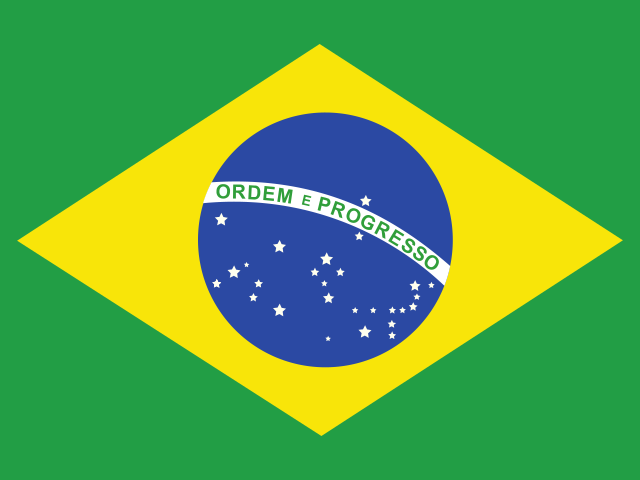
It is time to resume the offensive and inflict a defeat on denialism. Nature reminds us every day that we live on one planet. The glaciers in the Himalayas are melting. The super El Nino may cause torrential rains, droughts and forest fires in different parts of the globe. Its effects will hit the most vulnerable, the hardest. Brazil has been demonstrating that it is possible to combine economic growth with reduced emissions. We have achieved our self-sufficiency in oil and will continue to explore the potential of new reserves, such as those in the equatorial margin. But we will not abandon the environmental agenda. We will move forward with the roadmap for the decarbonization of the Brazilian economy. The Tropical Forest Forever facility, launched at Cop 30 in the city of Berlin, shows that it is possible to change old paradigms. The forest is worth more standing than destroyed. We will continue to reduce deforestation, which has been cut in half in the Amazon and reaching its lowest level in 11 years. We have the moral authority to reject protectionist measures disguised as commitment to the environmental cause. Brazil is a global reference in green energy. We have the critical minerals and the rare earths that the world needs to make the energy transition. Our natural wealth belongs to the Brazilian people, and it is in their benefit that it will be exploited.
Chile understands that in a multipolar world, institutional stability is not a luxury, it is a need. For example, we are a pioneer in the energy transition. Chile possesses around a quarter of global lithium reserves, and we are the largest producer of copper on the planet. Chile has a lot of sunlight, the heat of the sun, a long Pacific coast, lakes, rivers, volcanoes that can create vast stores of energy. Chile also has the Strait of Magellan, a crucial alternative route for global trade. Our nation will become the bridge and the port for the bioceanic corridors that will unite America with Asia. This richness, this wealth is not only fortune that we have in our coffers, it brings with it responsibility. Responsibility to you. Chile will never renounce its sovereignty. Neither will it cease to exploit its own minerals. We have our sovereignty, of course, but at the same time, we say that the energy of the future must serve humankind, and energy must not be held hostage by monopolies or actors that do not abide by the rules. Please make no mistake here it is possible to reconcile growth and sustainability. The two are inseparable. Chile understands that environmental protection and economic progress form part of one single development strategy one in which investment and innovation are linchpins when it comes to improving the quality of life of our people. Sustainable development requires robust institutions, clear rules, timely decisions and effective administration able to turn commitments and diagnoses into tangible results for both people and the environment. President, I now wish to turn to a discussion of our continent, Latin America, because I sincerely believe that the coming decade can be ours.
Dominica has begun the transition from imported fossil fuels to renewable energy. Our geothermal power plant is now in commercial operation and increasing the renewable share of our electricity generation to approximately 84%. We are well on our way to achieving 100% renewable energy by 2030. This is more than an energy project. It is economic transformation. It demonstrates that small states can lead in the transition to clean energy. Every barrel of oil that we no longer need to import strengthens our resilience to international price shocks. Every unit of clean electricity we produce strengthens our energy security. Affordable, reliable, renewable energy can become a foundation for new industries, new investment, new employment, and greater competitiveness. The lesson is important beyond Dominica. We need international finance that recognizes the transformative nature of renewable energy investment in vulnerable countries. We need financing mechanisms that allow countries such as Dominica to move faster and we need partnerships that allow the energy transition to become an engine of economic development and growth. Our ambition is not merely to generate clean electricity. Our ambition is to use clean energy to transform our economy. Mr. president, the international community has become very good at recognizing vulnerability. We have become less successful at financing the transformation that vulnerability requires.
It is no longer acceptable for the world to regard the Sahel merely as a source of resources, an arena for international competition, or a footnote in global decision-making. Africa, whose journey we have followed since the founding of the African Union, is not the margin of the world; it is one of the centers of the world to come. Libya does not lie on the edge of Africa; Libya is of Africa, of its history, of its security, and of its future. Decades ago, an African will emerged from the Libyan city of Sirte that contributed to the establishment of the African Union. That fact reminds us that Libya has never been merely a bridge between Africa and the Mediterranean, but a partner in shaping the African project itself. We, therefore, view the security of the Sahel region as part of Libya's own security and stability. We view the security and stability of the states of the region and all our African neighbors, near and far, together with developing Africa, all as investment in the common security of Africa and its European neighborhood. This is not assistance provided by one party to another, nor is it a responsibility borne by one party alone. Likewise, we view the Mediterranean basin not as a barrier between Africa and Europe, but as a shared space of connection. Relations among its countries should move from beyond merely managing migration and crises toward making the Mediterranean a bridge for development, trade, energy transition, investment, and common security. Ladies and gentlemen. Geographically and politically, Libya stands at the meeting point of these worlds.
Within the framework of the National Development Plan 2025-2044, Mozambique is committed to transforming its potential into shared prosperity for the people through the valorization of resources and investing in human capital, especially in the youth and women, which are the majority. We also want to increase value to natural resources. We also want to modernize our agriculture, promote industrialization, develop tourism, expand access to energy, invest in infrastructures, education, health, science and technology, digitalization, and in the economy in general. Natural resources should contribute to the economic diversification of our economy, the mobilization of income, and investment in our biggest asset, which is the talent of the Mozambican people and the talent of the African people. Our location in the Indian Ocean, our logistic corridors, and our agricultural potential, energy, and minerals make Mozambique a strategic platform for investment and regional integration. We therefore seek partnerships that build national capacity, promote local content, respect the environment, and generate employment, especially for the young people and women. Mozambique will continue to diversify its partnership in a sovereign way, transparent, and mutually beneficial manner, working with all the parties in light of the national priorities. This is also Africa's ambition: to be the architect of their own destiny, to participate in setting the rules, and to fully benefit from the wealth it helps to create.
The absence of education, health care, decent employment, and the loss of homes and livelihoods to climate change leave communities as vulnerable as conflict itself. Our understanding of security must therefore extend beyond the absence of war to include the conditions that allow people to live with dignity, opportunity and hope. Mr. president, in The Gambia, this understanding has guided our democratic journey from 2017 to date. We have undertaken the difficult work of rebuilding institutions, strengthening the rule of law, expanding access to justice and confronting the legacy of past human rights violations. Our transitional justice process continues through implementation of the recommendation of the Truth, Reconciliation and Reparations Commission. We have strengthened institutional accountability, established the Special Prosecutor's Office to advance investigations and prosecution arising from the TRC process. We are proud of the progress we have made, but we remain conscious that democracy is never a finished project and requires continuous institutional strengthening, adherence to the rule of law, constitutional order, dialogue and consensus building on issues. On the 5th of December 2026, the government people will again exercise their sovereign democratic right to choose their president. This will be another important milestone in our democratic journey, and we need the support of the international community in this regard. Our government is committed to ensuring that the elections are peaceful, transparent, credible and inclusive, and conducted in accordance with our Constitution, national laws and democratic standards. This is the Democratic Party. Government remains committed to pursuing a path in which institutions are strengthened, citizens are heard, differences are resolved peacefully, and democratic gains are consolidated for future generations. Mr. president, on development, the government's recovery focused National Development Plan provides the framework for accelerating our socio economic transformation. We are investing in roads, energy, schools, healthcare, agriculture and digital infrastructure while promoting economic diversification, private sector investment and value addition. We are expanding opportunities for women and young people, improving lives, uncertainty, human capital upon which our future depends. I seize this opportunity to thank all the bilateral and multilateral partners of The Gambia for your continued support and partnership.
Our continent possesses the world's youngest population, vast arable lands, unparalleled cultural vitality and the critical minerals required to drive the global green energy transition. But, Mr. Speaker, let me warn Africa will not remain a passive arena for a new scramble for resources. Critical mineral extraction in Africa must not replicate the colonial era exploitation. We will process our minerals at home. We will build local industries that create dignified jobs for our youth, and we retain the value of our natural resources in Africa. The African Continental Free Trade Area, whose secretariat Ghana is proud to host, is our engine for Intra-african trade, structural transformation and industrial growth. As we heal historical wounds, we must address the alarming breakdown of the current global order. We are witnessing a dangerous shift towards unilateralism, lawlessness and the erosion of multilateral norms. The United Nations must learn from the lessons of the League of Nations. The UN charter must reign supreme over the cynical doctrine that might makes right The veto power must never serve as a license for impunity. Sovereign equality cannot be a privilege. Privilege that is reserved only for nations that are aligned with global superpowers.
Our continent holds vast mineral wealth, immense agricultural potential, extraordinary renewable energy resources, and the world's youngest population. We are a market of more than 1.5 billion people, increasingly connected through the African Continental Free Trade Area. These are not merely African assets. Properly developed, they are part of the answer to the world's search for food security, clean energy, resilient supply chains, and a new source of growth. Africa's resources must become the beginning of African industry, not the end of Africa's contribution to the value chain. Extraction defined too much of our past. Investment must underpin our future. This transition is already taking shape. Cocoa-producing nations are moving from bean to brand. Cotton producers are building government value chains. And Africa has made its position clear. The clean energy transition must not become another extractive transition. The African Continental Free Trade Area must be more than a market for what Africa already produces. It must become the platform on which Africa makes more of what it now imports. Kenya intends to be part of that transformation. In the next one week, we expect to break ground on the East African refinery in Lamu. A refinery capable of producing 700,000 barrels of oil a day, an investment of approximately $16 billion. Its significance extends beyond one project or one country. It represents the Africa we seek to build. Adding value at home, creating jobs for our people, and building industries capable of serving continents and global markets. That transformation should be financed using foreign and domestic resources. And that is what we intend to do, including the more than $4 trillion in domestic capital across pension funds, insurance assets, sovereign wealth funds, banks, and other institutions in Africa. The task is to mobilize more of that capital for productive investment while building the safeguards, credible projects, and financial instruments that long-term investors require. The imbalance is not only about money.
Poland will be the voice of this region as a country that understands both the challenges of development and the importance of stable rules of the game in the international economy. Central Europe, a co-founder of the Three Seas Initiative, is not merely a region catching up with the more developed parts of the continent. It is a region of dynamic growth, rising innovation, and exceptional drive. It is one of the most promising areas for economic development in the world. The foundation of this dynamism is cooperation, including in the areas of infrastructure and energy, strengthening transportation links, developing north-south corridors, and investing in security and diversification of energy sources. All of this is translating directly to building the resilience of our economies. Energy sovereignty, including the one based on nuclear energy, is not a choice today. It is a prerequisite for security and political independence. The experiences of recent years have clearly shown that countries capable of making themselves independent from energy pressure are also more resilient to blackmail and destabilization. That is why we view the development of regional cooperation as an essential contribution to building a more stable and predictable global economic order. We believe that we must respond jointly to the challenges of the 21st century. For us, natural partners in this effort also include countries in Africa, Asia, and Latin America, with whom we share the experience of development, the ambition to modernize, and the drive to strengthen sovereignty. I believe that everyone will benefit from Poland's membership in the G20. This year, we are participating in the group's works at the invitation of the current presidency, the United States. I would like to thank President Donald Trump very much for inviting us to the G20 summit. We are actively participating in preparations for this event, which will take place in Miami this December.
The climate crisis is now a national security threat for countries around the world, as this summer of extreme heat, wildfires and floods has proved beyond doubt. Britain will continue to lead with others to fight this threat, to protect our children and grandchildren, to protect the natural world and also to seize the benefits for jobs, growth and reindustrialisation that the clean energy transition can bring. So we must raise our sights and I believe the United Kingdom has a unique position as an honest broker to help drive this forward. We are America's closest ally. We have deep ties with our friends in the European Union and seek to deepen them further. We work with China and emerging powers like India and Brazil. We sit on the UN Security Council in the Commonwealth, in the CPTPP.
Minister Murat Kurum, representing the incoming Cop 31 presidency, has put the challenge plainly the time for simply setting out goals is behind us. Anyone who experienced this summer in Europe and elsewhere knows that it was the hottest on record, and the super El Nino has not even yet hit. The proposed action agenda places methane reduction at the centre of climate implementation, and we welcome that focus. It is true that carbon dioxide must remain central to the global energy transition, but emissions are not falling quickly enough, and the full benefits of action will take time to emerge. So, Mr. President, under Barbados's presidency of the Cvf Climate Vulnerable Forum and its G20 countries, 74 countries got together and advanced the call to pull the methane emergency brake at the G20 Ministerial Dialogue in April of this year. The finance ministers agreed that methane reduction must be treated not only as an environmental priority, but also an economic, fiscal and public health opportunity. We must now implement the climate. Vulnerable countries need to mobilise approximately $490 billion each year by 2030, and yet the current inflows are roughly $90 billion. As a young people in Barbados would say, the math simply ain't math. We must also correct the inequity of the borrowing costs that these countries face. It is almost 1.2 percentage points higher for climate vulnerable countries than for advanced economies. Now that figure seems small to you, but that actually generates an estimated $62 billion more a year in excess interest payments each year.